Hands-off list software
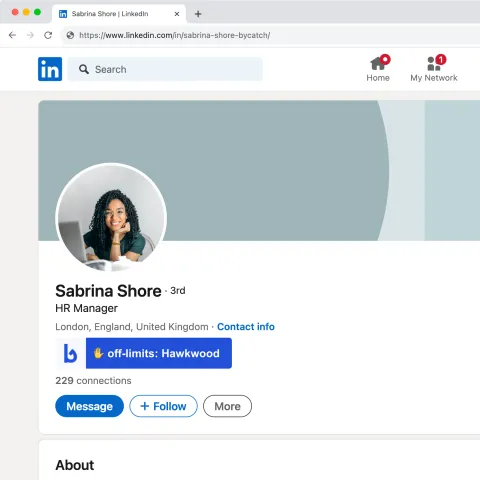
Your hands-off list, shown on LinkedIn before anyone sends a message
A hands-off list is the set of companies your firm has agreed not to recruit from: current clients, recent clients inside a protection period, and companies in your own group. Most firms have one. Most firms keep it in a spreadsheet that nobody opens mid-search.
Bycatch puts that list where sourcing actually happens. Candidates who work for a hands-off company get a clear flag on their LinkedIn profile, for every consultant on your team, automatically.
The problem
Why hands-off lists get broken
Almost no agency approaches a client’s staff on purpose. It happens because the list and the sourcing are in different places.
The list lives somewhere consultants don’t source
Your team sources on LinkedIn. The hands-off list is a spreadsheet, a CRM tag or an email from six months ago. Every approach depends on someone remembering to cross-check.
New joiners don’t know who’s protected
The consultant who knows every client by heart isn’t the one who makes the mistake. It’s the one who started last month and was never sent the list.
Protection periods quietly expire, or quietly don’t
Clients stay on the list long after the protection period ends, or fall off it while they’re still protected. Either way, nobody is sure what the list actually means today.
What Bycatch does
One shared list, enforced at the point of contact
Mark a company hands-off in one click
From the company’s LinkedIn page, or from your Bycatch dashboard. Group companies and subsidiaries included.
One list, every consultant
The whole team shares the same list. Add a company and everyone’s browser knows within seconds; invite a new consultant and they inherit it on day one.
Flags where the approach would happen
A clear notification on the candidate’s LinkedIn profile, in LinkedIn and LinkedIn Recruiter, before a message is sent. Not in a report afterwards.
Candidate data never leaves the browser
Bycatch reads the profile on your screen and flags it locally. It doesn’t log or transmit who you viewed. The only thing shared is which companies are which.
What it isn’t
Bycatch is a warning at the moment of approach, not a surveillance tool. It doesn’t read your consultants’ messages, it doesn’t monitor email or phone, and it doesn’t keep a record of the candidates your team looks at. If a consultant is determined to approach a protected candidate, software won’t stop them; that is what your contracts and your management are for.
What it does stop is the far more common case: a consultant who simply didn’t know. That is the gap a spreadsheet leaves open, and it is the gap Bycatch closes. For how that compares with the other ways teams run a hands-off list, see memory vs spreadsheet vs ATS vs Bycatch.
FAQ
Hands-off list questions
The things recruitment teams ask before switching from a spreadsheet.
What’s the difference between a hands-off list and an off-limits list?
Nothing, in practice. “Hands-off list”, “off-limits list”, “do-not-approach list” and “client protection list” all describe the same thing: the companies a recruitment business has agreed not to source candidates from. Different firms use different words; Bycatch handles all of them the same way.
Does Bycatch stop a consultant sending the message?
No. Bycatch is a warning, not a block. It puts a clear off-limits flag on the candidate’s profile at the moment a consultant is deciding whether to approach them. That is where almost every accidental approach happens, and a visible warning at that moment is what prevents it. It does not control email, phone or other channels.
Can I see who is on the hands-off list?
Yes. The full list is in your Bycatch dashboard, where anyone on the team can see which companies are protected and add or remove them. There is no separate list per consultant: it is one list for the whole team.
Does it work with LinkedIn Recruiter?
Yes. Flags appear on candidate profiles in both standard LinkedIn and LinkedIn Recruiter, as long as the consultant is using Chrome with the extension installed.
How much does hands-off list software cost?
Bycatch is priced per team, not per seat: from £30 a month for up to five users, with larger team plans above that. Every plan is free for the first month with no credit card required.
Put your hands-off list where your team can’t miss it
Install the extension, invite your team and mark your first company in under two minutes.
- Free for first month
- No credit card required
- Set up in under 2 minutes